







The pharmaceutical industry is under time pressure: New drugs must reach market readiness quickly and safely. This requires in-depth knowledge and specialized analyses. However, ongoing production often occupies manufacturers' laboratory capacities. Fette Compacting solves this bottleneck through expanded laboratory services such as High-Performance Liquid Chromatography (HPLC).
Individual process developments, tailored solutions, and the focus on Quality by Design demand an ever-deeper understanding of formulations and processes in the pharmaceutical industry. "Many pharmaceutical companies have the expertise for complex analyses in-house – but their laboratories are occupied with day-to-day operations," explains Jonas Bethmann, Application Specialist at Fette Compacting. “With our expanded service offering, we bridge this gap and support our customers from the initial idea through to successful production.”
HPLC: From Sample to Result
As an established reference method, HPLC analytics enables the precise determination of active ingredient content in tablets and powder mixtures. The analysis process begins with sample preparation: The tablet is crushed, dissolved, diluted, and filtered. The sample is then pumped under high pressure through a column containing specialized particles. The various components react differently with the column material due to their chemical structure, allowing them to be separated over time. A PDA detector captures the separated substances. The result: specific signals displayed as peaks in a chromatogram, from which the active ingredient concentration can be calculated using a calibration function.
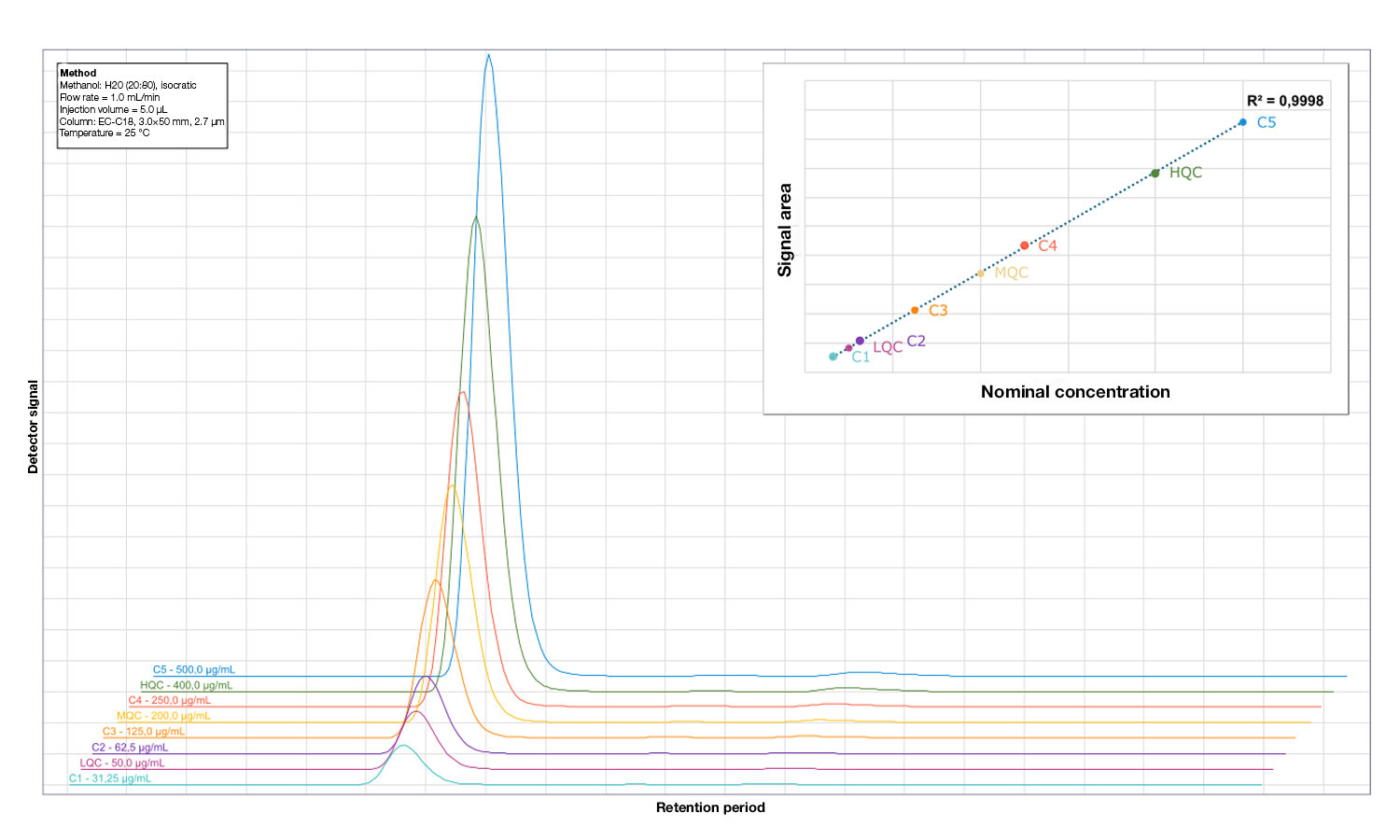
The intensity of the peaks in a chromatogram depends on the concentration of the respective substances.
A Powerful Duo for Continuous Process Control: HPLC and ePAT
A particular added value of HPLC analytics lies in its function as a reference method for modern process analytical techniques such as embedded Process Analytical Technology (ePAT). Fette Compacting's ePAT system continuously measures active ingredient content during production in a non-destructive manner using near-infrared spectroscopy.
"HPLC and ePAT complement each other ideally: HPLC delivers highly precise laboratory results but is time-consuming and destroys the sample. ePAT, on the other hand, tests each individual tablet without contact directly during the ongoing process," explains Bethmann. “We use the HPLC data to validate the ePAT results—this ensures that real-time measurement at production scale is just as reliable.”
Together, both methods form a robust quality control strategy that not only meets regulatory requirements but also significantly increases process efficiency.
The Benefits of HPLC Analytics from Fette Compacting at a Glance
Efficient Resource Utilization: Relieving internal laboratory capacities creates room for core tasks and new projects.
Accelerated Development: Integrated analytics services shorten the time-to-market for new pharmaceuticals.
Precise Reference: HPLC serves as the validation basis for modern real-time monitoring systems such as ePAT.
Consistent Quality: The combination of precise laboratory analysis and continuous process control ensures the highest standards.
Global Availability for Complex Requirements
For HPLC analytics, a specially equipped laboratory with modern infrastructure is available at the Fette Compacting Competence Center in Schwarzenbek. Through cooperation with the pharmaceutical contract manufacturer CMIC in New Jersey, expanded HPLC capacities are also available in the USA. This enables the development of complex processes even for highly potent active ingredients and supports pharmaceutical manufacturers worldwide in systematically optimizing their production workflows.
